Afraid to Speak Spanish? Here's Why You Freeze, and What Actually Works
The waiter asks if you want anything else. You understand him perfectly: every word. You even know your answer: no gracias, solo la cuenta. You've rehearsed sentences a hundred times harder than this one. And what comes out is a smile, a small wave of the hand, and English.
Later (on the walk home, in the shower, at 1 a.m.), the full sentence arrives, correct and fluent and completely useless. If you've ever typed why am I scared to speak Spanish into a search bar at that hour, this page is for you.
Here's the honest version, without the pep talk: freezing is not a talent problem, not a discipline problem, and not evidence that you're "bad at languages." It's the predictable result of how memory, attention, and anxiety interact, and it responds to specific kinds of practice, not to courage.
It has a name, and it isn't "being bad at Spanish"
If you're afraid to speak Spanish, you're in the most ordinary company there is. Researchers have studied this since the 1980s, when Elaine Horwitz and her colleagues gave it a name: foreign language anxiety, a situational anxiety specific to performing in a language you're still learning. Two things from that body of work are worth keeping in your pocket. It's common: ordinary, motivated classroom learners report it, not just extreme cases. And it isn't a symptom of being a weak student. The learners who freeze hardest are often the conscientious ones: the people who notice every error, care about getting it right, and would rather say nothing than say it wrong.
Read that last sentence again, because it reframes the whole problem. The freeze isn't the opposite of caring about Spanish. Very often, it is the caring, pointed in an unhelpful direction.
Freezing is a retrieval failure, not a knowledge failure
There's a real difference between recognizing a word and retrieving one: the difference between multiple choice and a blank page. When you read or listen, the word is handed to you and your brain only has to check it against what it knows. Speaking is the blank page: find the word, its gender, the conjugation, the word order, pronounce all of it, and do the whole assembly in real time while tracking your listener's face. That is heavy lifting for working memory in any language.
Add social pressure and it degrades in a very specific way: stress hits retrieval first. It's the same mechanism as blanking on a friend's name at the exact moment you introduce them. You didn't forget the name. Access failed under load. Your Spanish is still in there. The road to it was just briefly closed.
The affective filter: anxiety isn't a side effect, it's the mechanism
In the 1980s, the linguist Stephen Krashen proposed what he called the affective filter hypothesis: when anxiety runs high or confidence runs low, an emotional filter goes up between you and the language, and less gets through. It's a hypothesis, not settled physics, but four decades of learners have recognized themselves in it, and its practical implication has held up well: lowering the emotional stakes isn't a kindness you extend to yourself instead of learning. It's a condition for learning.
Krashen also described a character you may recognize: the monitor over-user: the learner whose internal grammar-checker runs so loudly that speech comes out halting or not at all. Every sentence gets drafted, audited, and rejected before it reaches the mouth. If that's you, notice the shape of it: the same carefulness that makes you accurate on paper is what's making you silent out loud.
Why you understand so much more than you can say
This gap frustrates everyone, so let's normalize it: your passive vocabulary is always larger than your active one, even in your native language. You recognize thousands of English words you'd never actually use. Comprehension is also simply more forgiving: to follow a sentence you only need the gist, and context fills the holes. Production forgives nothing. Every slot in the sentence has to be filled by you, on time.
There's a plainer reason too: most of us have practiced comprehension a hundred times more than production. Reading, listening, matching, tapping tiles: the standard study diet is overwhelmingly recognition work. Speaking in real time is a different exercise, and it's the hard one; even Duolingo's own team has written that real-time conversation is the hardest part of learning a language.
Which means something worth saying clearly: your streak wasn't wasted. Every word you can recognize is raw material. You didn't fail to build the warehouse: you built a very full one, and it's waiting. Activation is a different exercise, not a do-over. (If you're taking stock of what your app years gave you and what they didn't, I've written an honest comparison of Axo and Duolingo.)
Why "just go talk to natives" backfires
It's the most common advice on every forum, and it comes from a good place: real conversation is the goal. But look at what the advice actually prescribes for an anxious learner: perform, in real time, in front of the exact audience you fear, with zero repetitions at lower stakes first. If a friend feared heights, you wouldn't start them on the cliff edge.
Real conversations also have a dynamic that quietly punishes hesitation, through nobody's fault. Kind native speakers fill your silences. They finish your sentences. They switch to English to rescue you: an act of pure generosity that lands, on a nervous system, as a verdict. The lesson your body takes home from those encounters is not "I need practice." It's "confirmed: I can't do this."
Immersion advice works beautifully for people who are already comfortable being publicly bad at things. If that's not you, the answer isn't more courage. It's getting your repetitions in before the stakes, not instead of them. Before them.
What actually works
- A high volume of low-stakes reps. The cure for freezing isn't one triumphant conversation; it's hundreds of unremarkable ones. Retrieval gets fast the way anything gets fast: through repetition, in conditions calm enough for repetition to happen at all.
- Private practice first. The audience is the single biggest input to the filter, so remove it. Narrate your morning in Spanish. Answer the podcast out loud. It feels ridiculous and works anyway: talking to yourself is retrieval practice with the stakes at zero. I've written a full guide to practicing spoken Spanish alone.
- Finish the sentence, even badly. Every abandoned sentence is a rehearsal of abandoning. Land it with the wrong gender and a mangled conjugation if you have to: a finished bad sentence teaches more than an abandoned perfect one, and finishing is itself the skill you're missing.
- Corrections as recasts, not red ink. Language teachers have a gentle move called a recast: instead of flagging your error, they reflect your sentence back correctly inside the flow of conversation. You say ayer fui al tienda; they answer ah, ¿fuiste a la tienda? ¿Qué compraste? You hear the fix, nobody stops the music, and there's nothing to be embarrassed about. Anxious learners need correction to arrive this way, because a correction that stings gets remembered as a sting, not as a fix.
- Make it boring and daily. Ten calm minutes a day beats a weekly hour of white-knuckling. You're not trying to become brave. You're re-teaching your nervous system that spoken Spanish is a normal, low-consequence activity, and boredom is what that feels like from the inside.
Full disclosure: I built an app around exactly this
This is the part of the essay where the product shows up, so let me be plain about it. I'm one person building an iOS app called Axo. It launched on the App Store in September 2026, free to download, and this page exists because the freeze is the specific problem I built it around. Every design decision traces back to a paragraph above:
- It waits for you. Conversation is tap-to-talk: you speak, and nothing is sent until you tap. The tutor never interrupts, never fills your silence, never finishes your sentence. Take ten seconds mid-sentence to hunt for a conjugation: nothing happens. The pause that human conversation punishes is exactly the thing Axo is built to protect.
- Nobody hears you practice. Speech recognition runs on-device, using Apple's built-in recognizer. Your raw audio never leaves your phone; only the transcribed text is sent, and only with your explicit consent. "Private practice first" isn't a tip in this app: it's the architecture.
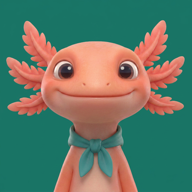
- Corrections are recasts. Your tutor (a small animated axolotl; there are three of them, Axo, Xolo, and Yara) replies out loud and weaves the corrected version of what you said into its answer, the way a kind teacher would. No red ink, no buzzer, no stopping the music.
- It remembers you. Your progress and the things you've told it carry over between sessions, so tomorrow's conversation starts where today's left off instead of from zero.
Axo is free to download, and there are no ads. If you're comparing tools in this space, I've also written up Speak and Praktika the same way I wrote this page: honestly, with sources.
Download Axo free on the App Store
Free to download, iOS only for now. Questions? Email me; I am the only person here and I reply personally.
Questions people actually ask
Why am I scared to speak Spanish?
Almost always it's a mix of two things: retrieval pressure (speaking makes you assemble words, grammar, and pronunciation in real time, which is hard under any spotlight) and social stakes (a listener whose time and opinion you care about). Researchers have called this foreign language anxiety since the 1980s. It's common, it's situational, and it says nothing about your ability to learn Spanish.
Is it normal to understand Spanish but not be able to speak it?
Completely normal: it's the default. Your passive vocabulary is always larger than your active one, even in your native language, and comprehension only requires the gist while speaking requires every piece of the sentence, on time. Production lags because it's practiced less, not because something is wrong with you. It catches up when you practice speaking specifically.
How do I stop freezing when I speak Spanish?
Lower the stakes before you raise the difficulty. Get a high volume of private, low-pressure speaking reps (talk to yourself, narrate your day, answer podcasts out loud) and practice finishing every sentence even when it comes out wrong. Freezing fades through repetitions in calm conditions; it rarely fades through willpower in stressful ones.
Should I just talk to native speakers to get over the fear?
Eventually, yes: real conversation is the goal. But as a first step for an anxious learner it usually backfires: the stakes start at maximum, and well-meaning partners fill silences, finish sentences, or switch to English, which your nerves read as a verdict. Do your first reps somewhere private and low-stakes, then bring your warmed-up Spanish to real people.
Can I get over Spanish speaking anxiety by practicing alone?
You can get most of the way there. Practicing alone builds the two things that stop the freeze: retrieval speed and the habit of finishing sentences. What it can't fully simulate is unpredictability, so climb the ladder: private reps first, then a patient conversation partner who never interrupts, then the real world. Each rung makes the next one boring, which is the goal.
One last thing about that sentence that showed up on the walk home: flawless, and too late. It isn't proof of a wall. It's proof of the warehouse. The Spanish is in there, all of it, waiting on a road that opens with calm repetition. Practice the retrieval, gently, and the sentences start arriving on time.