
A Guided Spanish Course You Speak Out Loud
Most Spanish courses have a quiet secret: you can finish them without ever really speaking. Videos explain, worksheets check boxes, and the talking is supposed to happen later, somewhere else, with someone braver. Axo's mission library flips that. It is a guided Spanish course where the speaking is the lesson: 68 missions, each one a six-to-nine-minute spoken conversation that ends when you have said, out loud, the thing it set out to teach you.
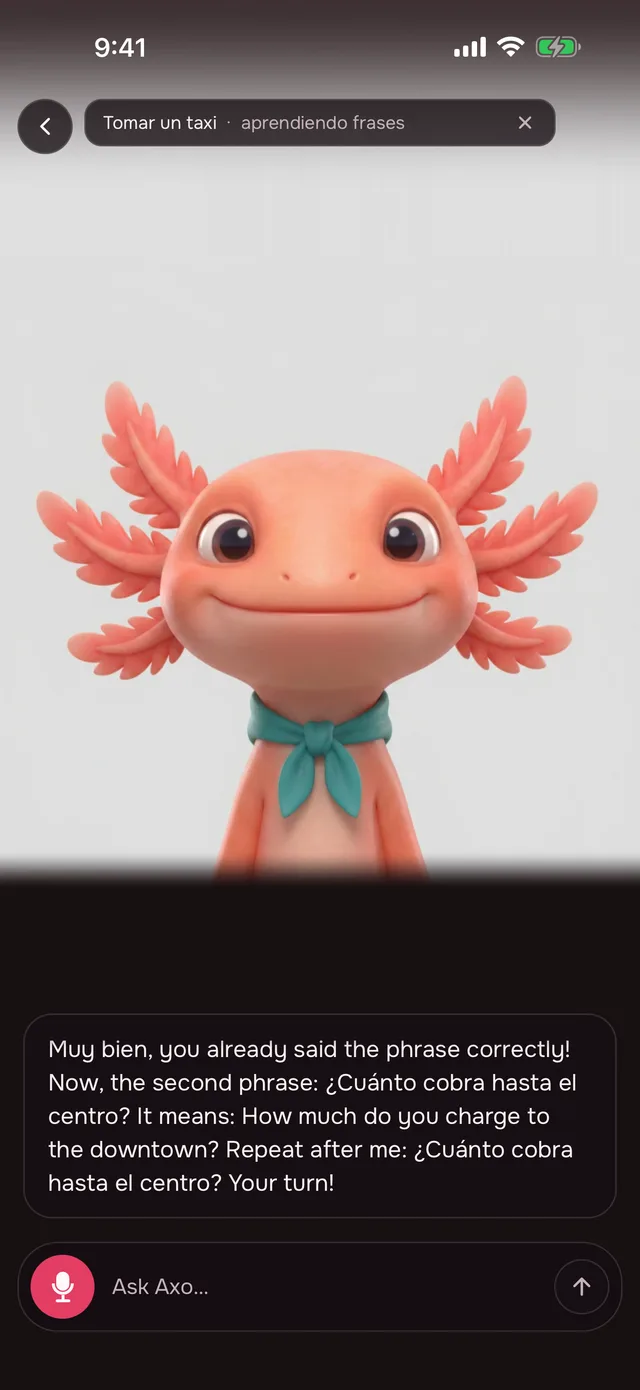
Here is how a mission works. Your tutor briefs you by voice: three phrases, taught one at a time, with the English right there when you need it. Then you use them in a real scenario, ordering at a taquería, rebooking a rained-out tour, pushing back in a meeting, while the tutor plays the other side. Finish the objectives and the mission wraps with what you can now do, then offers the next one without ever sending you back to a menu. No worksheets. No multiple choice. Your voice, a scenario, and a tutor who listens.
Five paths, one library
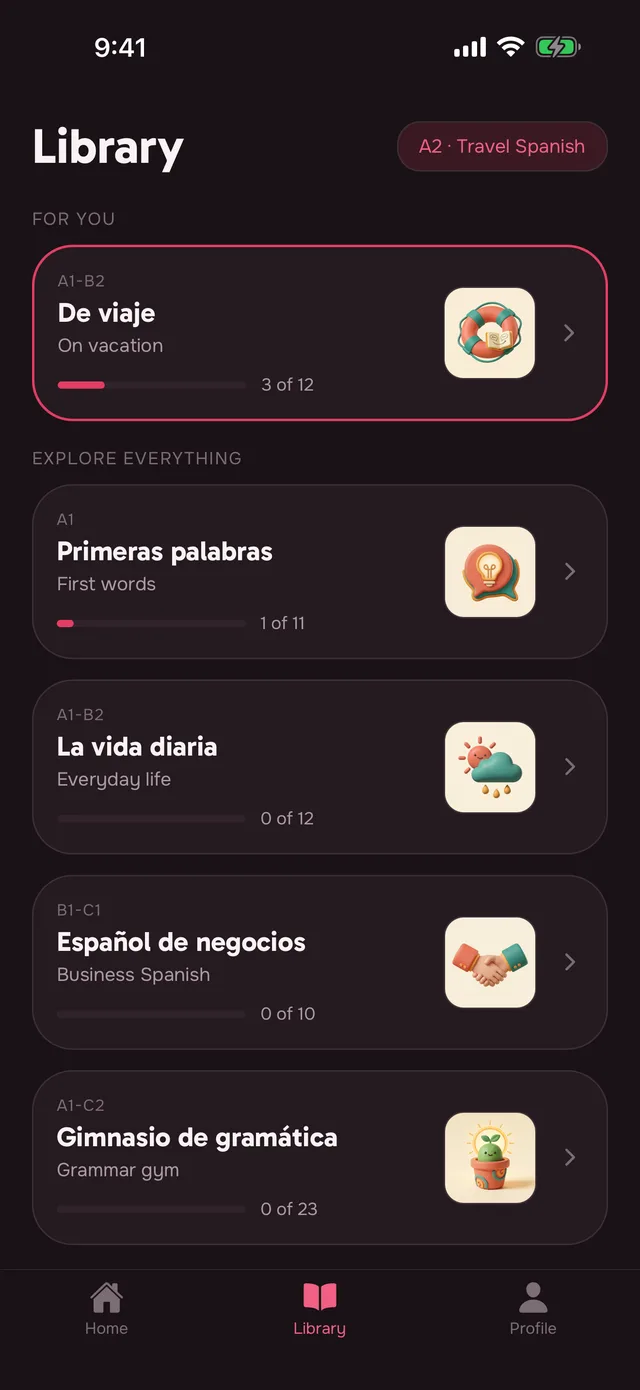
The course is organized as five paths. You tell Axo your level and what you want to practice during onboarding, and the library puts that first. Nothing is ever locked, and anything you already know you can mark as done and skip.
| Path | Missions | Levels | What you learn to say |
|---|---|---|---|
| Primeras palabras (First words) | 11 | A1 | Greetings, numbers, likes and dislikes, telling time, el and la, describing things. From absolute zero to your first real sentences. |
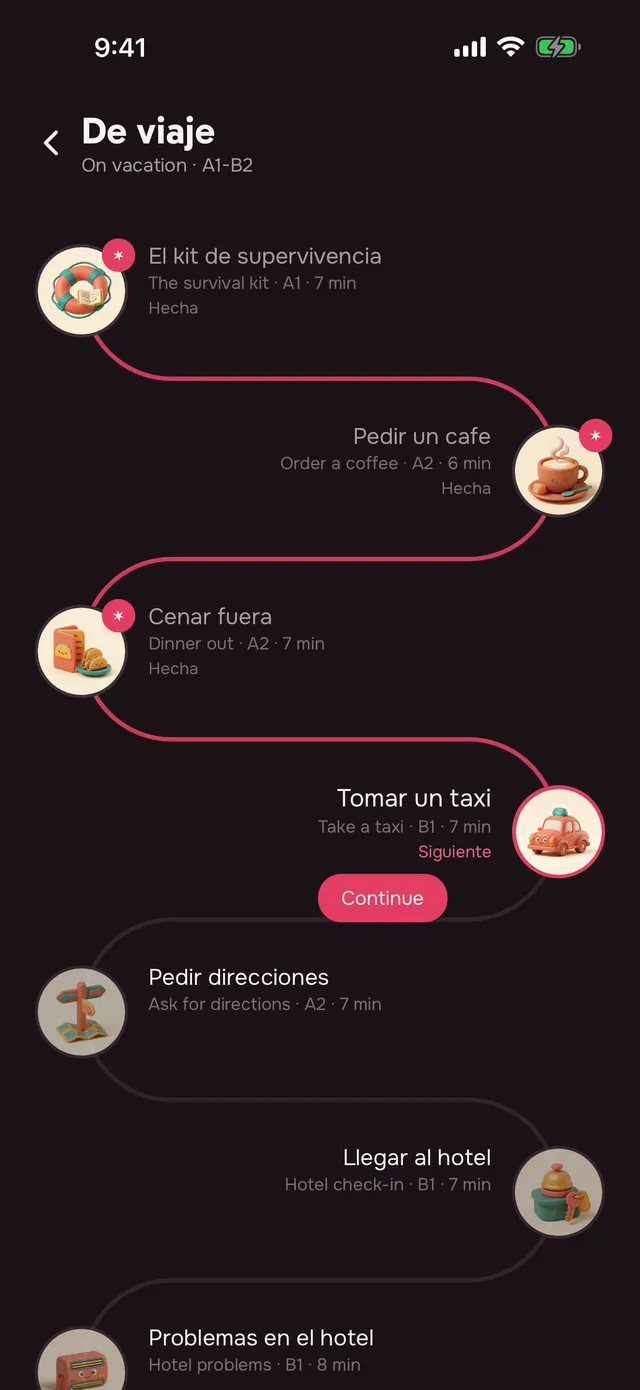
| De viaje (Travel Spanish) | 12 | A1-B2 | Order a coffee, take a taxi, check in, haggle at a market, handle a pharmacy, make friends at the hostel, and afterward tell the whole story in the past tense. |
| La vida diaria (Everyday life) | 12 | A1-B2 | Your routine, your family, Mexican food, cooking, fiestas, and two things textbooks skip: how Mexicans actually talk (qué onda, no manches) and texting language (te dejó en visto). |
| Español de negocios (Business Spanish) | 10 | B1-C1 | Introductions, calls, scheduling, speaking up in meetings, presenting, negotiating, feedback, and the job interview, in the usted register an office actually uses. |
| Gimnasio de gramática (Grammar gym) | 23 | A1-C2 | The whole conjugation system, one clinic at a time: ser versus estar, reflexives, both past tenses, the future, commands, the conditional, the subjunctive in three stages, por versus para, object pronouns, verbs of becoming. |
Not just repeat-after-me
Repeat-after-me is where speaking starts, not where it ends, so the missions change shape with your level. Beginners get the full scaffold: phrase, meaning, phrase again, then say it, plus quick spoken fill-in-the-blank quizzes so recall gets tested, not just echoed. By B2 the training wheels come off: the tutor introduces a phrase in context and asks you to use it in a sentence about your own life, then pushes into open conversation. In the advanced clinics you are debating, telling stories, and defending decisions; the grammar is just the muscle being worked while you do.
You also choose how to practice. Every mission offers the scene as a roleplay, or a straight drill if roleplay is not your thing that day. Either way the tutor tracks the phrases you have actually produced, and your progress is honest: a mission you completed with help is marked practiced, not mastered.
A course that knows your level
During onboarding you pick a goal level, A1 to C2, and what you want to practice: travel, everyday conversation, business, grammar, or a bit of everything. The library leads with your pick and keeps the rest one scroll away. The level filter works both directions: a complete beginner is never pushed into B2 grammar, and a B2 learner opening the grammar gym starts at the subjunctive, not at present-tense drills. Progress carries across sessions, and the phrases you learn in missions come back later in free conversation, because remembering is the tutor's job, not yours.
What this course is not
Honesty section. There are no certificates, no placement exams, and no worksheets; if you need a credential, a university program or the DELE exam is the right tool. Axo is also iOS-only and Spanish-only today, with a Mexican accent and Mexican manners. And a guided course, however good, is one leg of a real practice routine; the others are covered in our guide to every real way to practice speaking Spanish. What the missions give you is the part most routines are missing: structured speaking, every day, at your level, with something that answers back.
Free, private, and yours
Axo is free to download, with no ads. Speech recognition runs on your phone, so your voice never leaves the device; nobody hears you practice, including us. Missions arrive as a free update to the app.
Download Axo on the App Store and say your first phrase out loud today. If you are comparing options first, we keep honest comparisons with Duolingo, Speak, and Praktika.
Questions people ask
Is there a guided Spanish course app that focuses on speaking?
Yes. Axo's mission library is a guided Spanish course where every lesson is a spoken conversation: the tutor teaches you three phrases out loud, you use them in a real scenario, and the mission ends when you have actually said what it set out to teach. There are 68 missions across five paths: first words, travel, everyday life, business Spanish, and a grammar gym that runs from A1 to C2.
What is the best Spanish course for learning to speak?
The best Spanish course for speaking is whichever one makes you produce Spanish out loud, every session, at your level. Classroom courses and video courses teach about Spanish; your mouth only automates what it practices. Look for a course where speaking is the lesson itself, not the homework. That is the design principle behind Axo's missions, and it is also why a weekly human tutor or exchange partner pairs well with any app.
Does Axo teach business Spanish?
Yes. The business path has ten missions from B1 to C1: professional introductions, office small talk, phone calls, scheduling, speaking up in meetings, presenting a project, negotiating, giving feedback, job interviews, and defending a hard decision. Each one is a spoken roleplay with a realistic counterpart, in the usted register a Mexican office would actually use.
Can a complete beginner use a guided Spanish course?
A guided course is the best place for a complete beginner to start, because the hardest question at zero is what to say next. Axo's first-words path gives you eleven A1 missions with heavy English scaffolding: greetings, numbers, likes, telling time, el and la, describing things. You pick your goal level during onboarding and the library puts level-appropriate content first, so a beginner is never pushed into advanced grammar.
Does the course cover Spanish grammar like the subjunctive?
Yes. The grammar gym is 23 focused clinics covering the whole conjugation system: present tense, ser versus estar, stem changes, reflexive verbs, gustar, both past tenses, the perfect, the future, commands, the conditional, the pluperfect, and the subjunctive in three stages, plus por versus para, object pronouns, impersonal se, reported speech, and verbs of becoming. Each clinic drills one structure inside a real conversation instead of a worksheet.
Is Axo's Spanish course really free?
Axo is free to download on iOS with no ads. Speech recognition runs on your phone, so your voice never leaves the device. The missions arrive as a free update; if that ever changes we will say so plainly on this page.